
How to Search the Graham County Court Docket
Start a Graham County court docket search with the free Arizona Judicial Branch Public Access to Court Information service. It indexes case information from courts across the state, including many Graham County matters. A verification screen comes first. Type the complete case number if you can. A party-name search works too. Spelling and the court filter matter. Remember that Public Access refreshes each Friday with data through Wednesday, so it is an index rather than a live clerk record.
Read the court name on your citation, notice, or order before anything else. Graham County Superior Court, Graham County Justice Court, and Gila Valley Consolidated Municipal Court keep separate files. Match the court first. Then search.
- Pass the Public Access verification screen and choose case-number or party search.
- Narrow the result to the Graham County court named on the paperwork.
- Check the case number, status, court, events, and latest setting.
- Use eAccess only when an eligible Superior Court document is needed.
- Confirm urgent facts or request an official copy from the clerk that holds the file.
Graham County Public Access Gate
The statewide portal opens with a verification-word field. If Enter fails, click Submit instead. The official instructions recommend exactly that. Once inside, you can search by case number or party name and narrow the results by court. A judicial assignment, filed-event list, calendar entries, public charges or claims, outcomes, and public financial information may all appear. Coverage is broad, though not complete.
The official Arizona Public Access interface is where a Graham County court docket search begins.
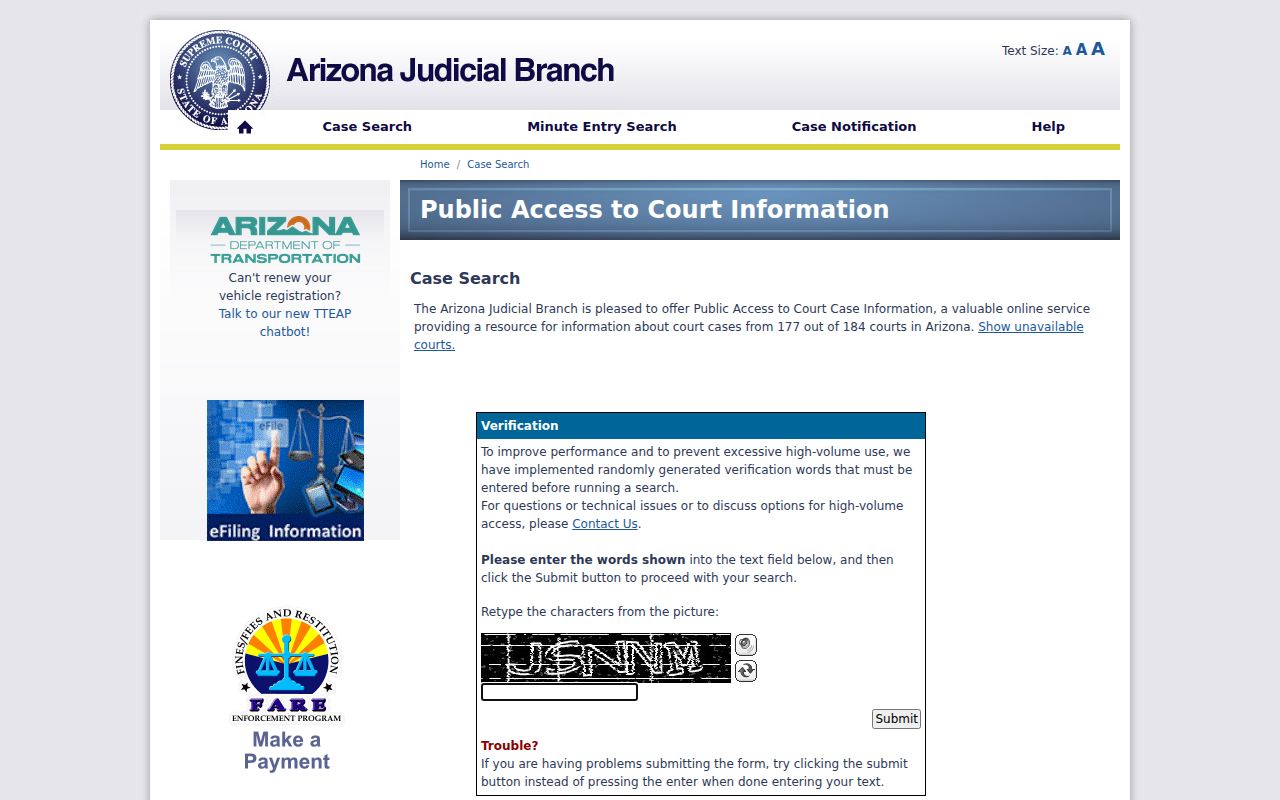
This screen opens an index, not a certified court file. A missing match can mean several things. The case may be excluded, involve a local ordinance, carry a misspelled name, or sit with a different Graham County court.
| Search field | Use | Practical check |
|---|---|---|
| Case number | Best unique key | Match the court prefix and full number |
| Last or business name | Party search | Use the spelling on filed papers |
| First name | Narrows people | Combine with the correct last name |
| Court or county | Limits results | Select the Graham County court when offered |
What a Court Docket Shows
In the statewide service, a Graham County court docket goes by the name case information or case history. It is a chronological index. Entries identify the court and case. Then they log public steps as they happen. One line may show a complaint, motion, notice, minute entry, or order being filed. A hearing line shows a date and type. The disposition records how a case or charge ended once the court enters it.
The docket is not the document. A motion entry proves a request was filed, not granted. A hearing line without a result does not prove cancellation. The judgment, order, or newest minute entry supplies the operative language.
| Case number | The court-assigned identifier used to search and request copies. |
|---|---|
| Parties | Public participants and their procedural roles, plus counsel when shown. |
| Events | A dated list of filings, notices, minute entries, and court action. |
| Settings | Public hearing date, type, judge, and location fields when available. |
| Status | The current recorded posture, which must be read with recent events. |
| Disposition | The recorded outcome of a case or an individual charge. |
Graham County Docket Codes
Graham County Justice Court publishes short case-type codes. The codes signal jurisdiction quickly and describe the kind of file. They say nothing about who won or what the judge ordered. A felony can start under a Justice Court code. It later gains a new Superior Court case history once probable cause or an indictment moves it upward.
- CT
- Civil traffic case in Graham County Justice Court.
- CTR
- Criminal traffic matter in the Justice Court.
- CM
- Non-traffic misdemeanor criminal case.
- CV
- Civil, eviction, or protection category used by the Justice Court.
- CF
- Felony matter at its preliminary Justice Court stage.
- SC
- Small-claims case within the court's published limit.
Codes belong with the court name. Read them beside the chronological events. An initial appearance or preliminary hearing in a CF history may lead to a separate Superior Court prosecution, which is a jurisdiction change rather than a duplicate final case.
Which Courts Keep Dockets
Arizona gives each county a general-jurisdiction Superior Court. The Superior Court of Arizona in Graham County handles felonies, major civil cases, family, probate, juvenile, and other matters assigned by law. Graham County Justice Court and Gila Valley Consolidated Municipal Court hold narrower classes of cases. Each keeps its own files. On a citation, the badge agency often decides the court.
| Court | Graham County docket covers | Records contact |
|---|---|---|
| Graham County Superior Court | Felony, general civil, family, probate, juvenile | Clerk of the Superior Court |
| Graham County Justice Court | County or state traffic, misdemeanors, civil claims, small claims, evictions, felony first stages | Justice Court clerk |
| Gila Valley Consolidated Municipal Court | Safford, Thatcher, and Pima police citations and city-code cases | GVC Municipal Court clerk |
A sheriff or Department of Public Safety citation normally lands in Graham County Justice Court. City police tickets go to the relevant GVC division. If geography seems unclear, trust the printed court.
Graham County Court Docket Systems
Public Access, eAccess, and eFileAZ sound alike. Each does a different job. Public Access is the free informational index. eAccess is an account-based service for eligible civil and criminal Superior Court documents filed on or after July 1, 2010. eFileAZ lets filers submit documents to participating courts. Filing access, though, does not equal public document access. The Arizona Judicial Branch eAccess overview explains the post-2010 document service.
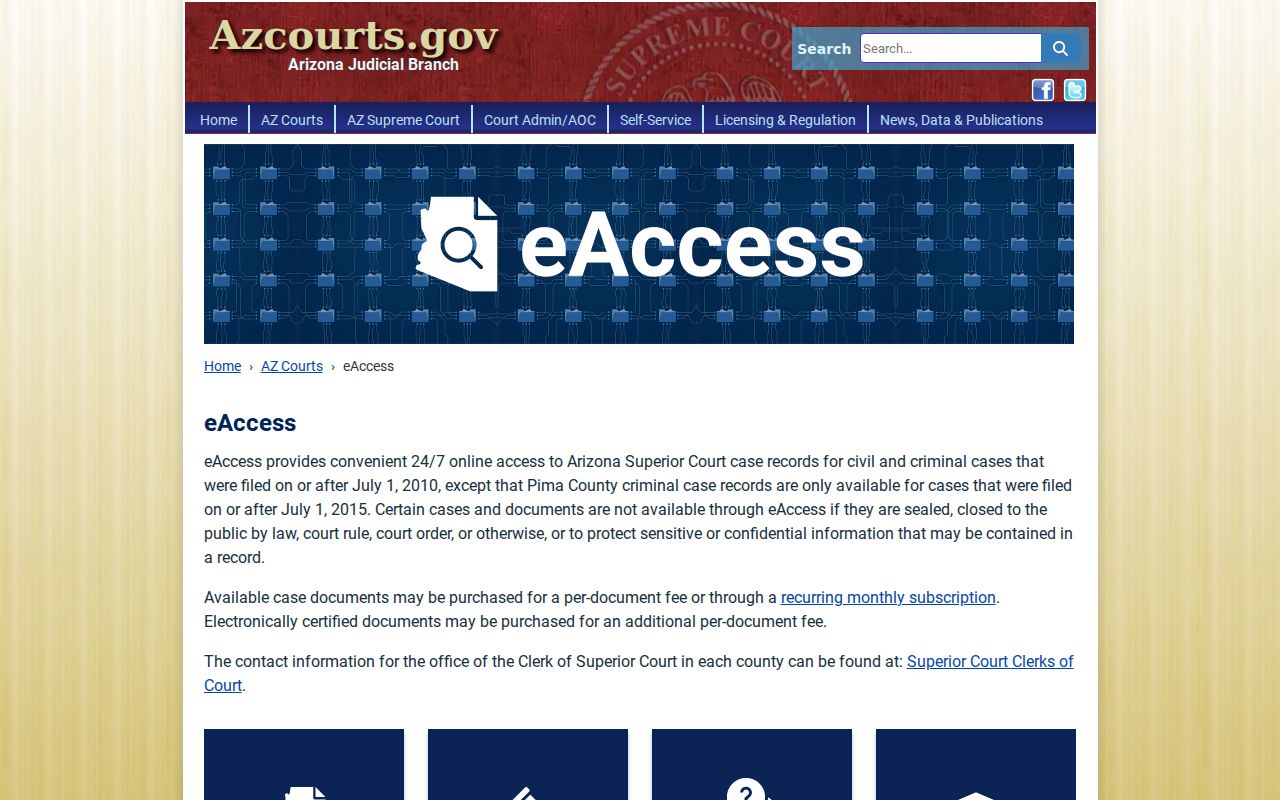
The distinction prevents two common errors. Paying for a filing image is not the same as obtaining a clerk-certified copy, and submitting through eFileAZ does not make a filing instantly visible in Public Access. Older records and unavailable documents go back to the clerk. That office is the Graham County Clerk of the Superior Court.
- Public Access
- Free case history and public settings, with a weekly refresh and stated exclusions.
- eAccess
- Account-based search and purchase for eligible Superior Court documents, subject to date limits, fees, and confidential gaps.
- eFileAZ
- Submission system for filers in participating courts, not a public docket search.
Finding Court Dates and Settings
Graham County publishes separate Outlook calendars for Superior Court, Judge Pro Tem, and Justice Court through its Court Calendars and Virtual Hearing Links hub. Other sources help too. A served notice, a recent minute entry, and the case history all carry hearing dates. Compare dates carefully. A reset leaves the old setting in the chronological history.
Record the date, time, court, judicial officer, and setting type. Then find the most recent notice or order. Public Access can lag a change made after Wednesday. So call the court that set the hearing. Superior Court answers at 928-428-3100, Justice Court at 928-428-1210, and GVC at 928-432-4090. The full Graham County court calendar explanation follows each local channel and the response to a missed setting.
Setting flow: Notice › Calendar entry › Reset or hearing › Minute entry › Next setting.
A caution applies here. After a continuance, an older setting stays in the case history, so the latest dated court notice should control the next step.
Graham County Court Calendar Split
Graham County splits its court calendar by judge and by court. Presiding Superior Court Judge Michael D. Peterson keeps a published calendar and a Zoom room. Pro Tem Judge Travis W. Ragland has links of his own. Justice Court posts a separate calendar. GVC trial status comes from that court's clerk and jury line. So do not assume every city matter shows up on a county Outlook feed.
Setting labels tell you what a hearing is for. An initial appearance covers rights and release conditions. A preliminary hearing tests probable cause in a felony before any transfer. Arraignment deals with the charge and the plea. A pretrial conference checks readiness and open issues. A continuance just moves the setting; the earlier event still happened. A Graham County court docket can show two dates. Call the court and ask which order controls.
Quick check: Public Access refreshes weekly. A Thursday reset may not appear there until the next update, while the court's own calendar or clerk may have the newer date.
Public Access to Dockets
Public access to Graham County court records runs through Arizona Supreme Court Rule 123. What you can view from home can be narrower. The full lawful view may only exist at a court facility. The county calls most Superior Court files public, but sealed and confidential categories stay protected. Public Access also leaves out some categories. And it warns that its results are not the official court record.
Key rules:
Arizona Supreme Court Rule 123 establishes access to judicial records and the limits on confidential and remote material.
A.R.S. §39-121.01 addresses preservation, prompt lawful inspection, copies, postage, and records withheld by a public body.
A.R.S. §8-208 sets special juvenile access rules and closes adoption, severance, and dependency records to general inspection.
Some records never reach statewide results. Protection orders, mental-health files, probate, victim or witness data, and juvenile delinquency information may all be absent. Local ordinance charges can be missing too, and that gap is about coverage, not confidentiality. The right move is to ask the responsible clerk about lawful access. Do not assume no case exists.
Missing Graham County Court Dockets
A blank search is just the first step of the fallback chain. Recheck the case number and party spelling. Then confirm which court holds the docket. An older Superior Court case may have an index entry but no eAccess document image. Probate and mental-health matters sit outside Public Access. City ordinance charges may need the GVC clerk. A felony can also carry a Justice Court preliminary history. A later Superior Court number may follow it.
For an ordinary public Superior Court file, reach the clerk by phone. You can also use the first-floor counter. The county copy form can go to the office or to superiorcourtforms@graham.az.gov. Send Justice Court and GVC requests to those courts. The elected Superior Court clerk does not certify their separate records. Before traveling, ask whether a public-access computer is available. The county IT plan inventories public-access PCs. The public-facing office page does not promise a particular terminal or its hours.
Note: A search exclusion protects or limits information. It is never permission to bypass a seal, confidentiality rule, or court order.
The Clerk and Docket Records
Heidi Torrio serves as Graham County Clerk of the Superior Court. Her office dockets every filed Superior Court document. It records proceedings through hearing clerks and stores exhibits. It provides inspection plus plain or certified copies of Superior Court records. It does not stand in for the separate clerks of Graham County Justice Court or GVC Municipal Court.
The county Request for Court Records form wants the case number or year filed. It also wants party names, document dates and titles, delivery details, and whether you need certification. Supply a case number or at least the year. That dodges the published $35 research charge. The form says the clerk will contact you within five business days about fees. That window covers fee contact only, not final delivery.
Graham County Clerk of Superior Court
800 W. Main Street, first floor
Safford, AZ 85546
928-428-3100
Monday-Friday, 8:00 a.m.-5:00 p.m.
Graham County Docket Copy Costs
Graham County prices copies in two parts. The paper or PDF costs by the page. Certification is billed for each certification. Shipping applies to mailed delivery. A missing case number and year can trigger a research fee, so precise docket details are worth gathering before you send a request.
| Item | Published amount | When it applies |
|---|---|---|
| Plain copy | $0.50 per page | Each reproduced page |
| Certification | $35 per certification | When a certified copy is requested |
| Research | $35 | If neither case number nor year filed is supplied |
| Shipping and handling | $8 | Mailed fulfillment |
Before ordering, ask the receiving office whether it needs an electronic certification or a raised seal. eAccess purchases and county clerk copies run on different fee systems. Download any eAccess purchase promptly, since the official service allows only a limited window.
Graham County Docket Technology
Graham County built its case-record system in stages. AJACS, Arizona's standard case-management system, reached the local Superior Court and clerk in 2008. Outlook calendars followed in 2015. Civil efiling started in 2018, and eAccess opened for Graham Superior Court in 2019. On March 30, 2026, Graham County Justice Court began taking eFileAZ filings in civil, eviction, and small-claims matters.
Each milestone covers a different link in the record chain. A case-management system records court activity. A calendar publishes settings. Efiling accepts documents. eAccess sells eligible images. No single one makes every Graham County court docket a real-time, complete public file. The 2026-28 county court technology plan also lists public-access computers and proposes more audio, remote-reporting, accessibility, and printer work. Treat proposals as plans, not installed services.
That timeline also explains why old and new records travel different paths. A post-2010 Superior Court filing may be purchasable online. An older or unavailable paper case goes back to the clerk form and counter.
Graham County Court Docket Scale
Graham County is small and spread out. The 2020 Census counted 38,533 residents. A 2025 estimate of 40,157 is spread across about 4,622 square miles. Its court network matches that scale. One Superior Court operation handles county business. A single consolidated Justice Court serves the county. One consolidated municipal court covers all three incorporated places. So a Graham County court docket search turns on jurisdiction. It does not turn on a long list of numbered divisions. Match the party or citation to the right court first.
Filing totals shift over the years. An old count tells you little about today's queue. The real lesson is procedural. The party or the citation tells you which court it is. That court's docket gives you the public case history. The clerk holds the official record. That chain holds no matter which Graham County court docket you pull.
Court Dockets by City in Graham County
The 2020 Census counts three incorporated places in Graham County: Safford, Thatcher, and Pima. All three share one court. The Gila Valley Consolidated Municipal Court keeps a separate originating division for each town. Its counter sits in Safford. So a police citation written in Thatcher or Pima still has its own city-level docket path inside the consolidated court. Sheriff deputies, DPS troopers, and other state officers file differently. Their cases usually land in Graham County Justice Court. That holds even when the incident happened just outside a town's edge.
Each card below points you to the right city docket. One caveat: the state Public Access system can miss a local ordinance charge. The GVC court itself remains the dependable fallback for a full case lookup. Consolidation also changed how requests work. Name the originating city division when you ask the clerk for court records. Otherwise the search may come back empty.
Safford Court Docket
10,129 residents in 2020. Safford police citations use the Safford GVC division.
Thatcher Court Docket
5,231 residents in 2020. Thatcher police record searches may take up to ten days.
Pima Court Docket
2,847 residents in 2020. Pima police citations use GVC at its Safford counter.
Map and Directions to the Graham County Courthouse
Superior Court files and the Clerk of the Superior Court are kept at the Graham County Courthouse, 800 W. Main Street, in Safford. The Clerk occupies the first floor, Superior Court sits on the second floor, and the CASA program and law library are in the basement. Graham County Justice Court also keeps a first-floor counter in the same building, but on a separate four-day schedule from the Superior Court clerk.
Graham County Courthouse
800 W. Main Street
Safford, AZ 85546
928-428-3100
Superior Court and Clerk: Monday-Friday, 8:00 a.m.-5:00 p.m. Justice Court: Monday-Thursday, 7:00 a.m.-6:00 p.m.
Justice Court is closed on Fridays even though the Superior Court clerk keeps normal weekday hours, so confirm which office is open before a Friday trip. No courthouse parking, transit, or security-screening details are published, so calling the clerk at 928-428-3100 ahead of a visit is the safest way to plan arrival.